The Shady Walk
Updated: Aug 4
In the archives of Harlow Moor, Pinewoods appears not simply as scenery, but as somewhere to disappear into. Walkers, naturalists and artists came for its shade, its wildlife, its changing light and the promise of a little distance from the town below.

Look closely at the old photographs and postcards of Harlow Moor and people are everywhere. They gather beneath the pines, wander through the heather in their Sunday clothes and stop where the woodland opens onto a view. An artist sits at an easel. A young girl peers into the gorse as though she has spotted something moving inside. These are not simply picturesque views of a vanished landscape. They are fragments of experience, showing how people used the moor and what they came there to find.
Harrogate below was ordered, cultivated and social. Its visitors moved between hotels, gardens, baths and pump rooms, following the rituals of the spa. Harlow Moor offered something different. It was higher, rougher and more exposed. Thorpe’s Guide described it in 1891 as a place where “firs, gorse and heather abound in profusion”. From its higher ground there were sweeping views across the country, with the roofs of Harrogate catching the sunlight below. The town remained close, but the sensation was of having stepped beyond it.

Many postcards gave this experience a name: The Shady Walk. It appears again and again, sometimes on Harlow Moor and sometimes within the Pine Woods. The title describes more than a path. It suggests the moment of passing from open ground into cover, when the light changes, the air cools and the wider world falls away behind the trees. Long before anyone spoke of forest bathing or restorative landscapes, shade itself was being presented as one of the attractions of the place.
For some, Harlow Moor was also a landscape to be studied. During the 1870s, the Harrogate historian and naturalist William Grainge regularly walked with the botanist John Farrah. On summer evenings, after the working day was over, the two men would cross Harlow Moor towards Birk Crag. It was here that Farrah first heard the strange, continuous call of a nightjar. Their walks were not merely a means of reaching somewhere else. They observed the plants, birds, geology and traces of older landscapes around them, reading the country as they moved through it.
Another remarkable figure was Riley Fortune, one of Yorkshire’s leading ornithologists and an early wildlife photographer. Fortune recorded that woodlarks had nested on Harlow Moor in 1880. His photographs later appeared throughout The Birds of Yorkshire, while his work for the protection of wild birds helped make him president of the Yorkshire Naturalists’ Union in 1915. In 1928, he appealed directly to Harrogate Corporation to establish a bird sanctuary on Harlow Moor. Almost a century ago, the moor was already being understood not only as open land for people, but as a living refuge deserving deliberate protection.
Artists were drawn upwards too. The archive includes the wonderful image of a painter working at an easel in the open landscape. Harlow Moor was also painted by artists including Alfred Robert Quinton and Ernest William Haslehust, who translated its pines, heather and distant views into the saturated colours of popular prints and postcards. Their pictures often catch the moor at its most atmospheric, when golden light falls across the heather and the dark pines rise against an evening sky. It was a landscape that invited people not simply to look, but to linger long enough to notice how completely it changed with the light.
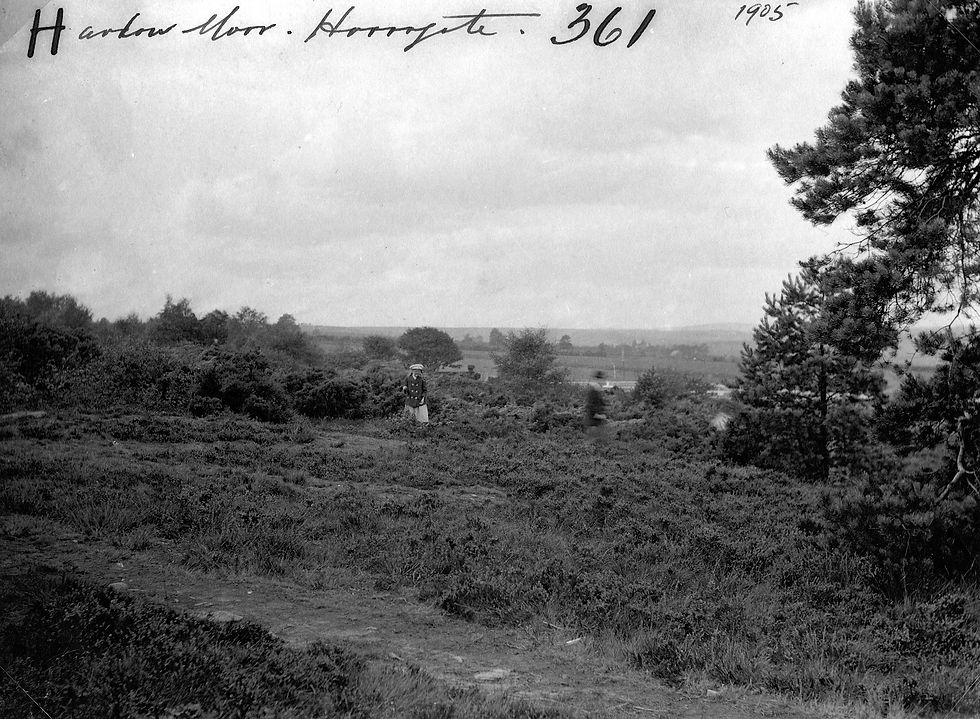
We cannot know precisely what every person in these photographs was thinking. Yet the images repeatedly show the same instinct: to leave the formal town and move towards something less arranged. People did not always follow a prescribed circuit. They wandered, explored, painted, watched for birds or simply found somewhere to sit. The moor allowed a little solitude, even when Harrogate itself was crowded with visitors. It offered room for curiosity and, perhaps, a certain freedom from the social rituals below.
That freedom belongs within the wider history of the Harrogate Cure. The Cure did not end with the taking of the waters. It continued through movement, fresh air, gardens, changing views and contact with the wider landscape. Harlow Moor provided its wilder counterpart: bracing ground above the town, where attention could turn outwards towards birdsong, weather, scent and light. People may not have described the experience in today’s scientific language, but they clearly recognised that something changed when they walked out of Harrogate and into the woods.
The archives therefore show us more than the former appearance of Pinewoods. They reveal a long culture of walking, observing and escaping into this landscape. Harlow Moor was a place of recreation in the oldest and richest sense of the word: somewhere the self might be made afresh.
Two hundred and thirty years after the first pines were planted, that invitation remains. Walk out of the town. Step beneath the canopy. Look closely. Listen for what is living there. The Shady Walk was never simply a route through the woods. It was a different way of being in them.

Comments