![Bogs Beck [Credit George Eglese].jpg](https://static.wixstatic.com/media/d4a71e_f037ec42d4d949cdad7e01aff877b042~mv2.jpg/v1/fill/w_100,h_67,al_c,q_80,usm_0.66_1.00_0.01,enc_avif,quality_auto/d4a71e_f037ec42d4d949cdad7e01aff877b042~mv2.jpg)
Springs
More than eighty mineral springs rose to the surface in and around Harrogate - an extraordinary concentration that exists almost nowhere else on earth.
No two are quite the same. Some carry iron, some carry sulphur, and every one of them was, at some point, somebody's reason for travelling here.
![Pump Room 2 [Credit George Eglese].jpg](https://static.wixstatic.com/media/d4a71e_d287dfb900f441f98ca11bcabf3cbdfd~mv2.jpg/v1/fill/w_980,h_636,al_c,q_85,usm_0.66_1.00_0.01,enc_avif,quality_auto/Pump%20Room%202%20%5BCredit%20George%20Eglese%5D.jpg)
![Bogs Beck [Credit George Eglese].jpg](https://static.wixstatic.com/media/d4a71e_f037ec42d4d949cdad7e01aff877b042~mv2.jpg/v1/fill/w_980,h_653,al_c,q_85,usm_0.66_1.00_0.01,enc_avif,quality_auto/Bogs%20Beck%20%5BCredit%20George%20Eglese%5D.jpg)
Nature's laboratory - why the water rises here
The water that surfaces in the Old Sulphur Well, by one long-held account, has been on its way for as long as 20,000 years - not falling as rain and filtering down, but rising up from deep below, born in the heat of ancient magma far beneath the rock that now sits under the town. If that's right, it makes Harrogate's springs a different category of thing entirely from an ordinary mineral spring fed by rainfall: water that was never rain at all, but something older, climbing slowly up through the Earth's crust and picking up its mineral character - iron, sulphur, salts - from every layer it passes on the way.
Whatever the precise mechanism, supposedly nearly ninety separate springs once broke the surface in and around the town, thirty-six of them in the single stretch of ground now called Bogs Field, and remarkably, no two are identical.
Each one has taken its own route up through the rock, which is exactly why some run rust-red with iron while others carry the unmistakable smell of sulphur. The full chemistry of how that happens is still, by most honest accounts, not fully understood - which only makes the place stranger and more worth paying attention to.
Tewit Well - the first
Tewit Well was the spring that started everything. Discovered in 1571 by William Slingsby, it gets its name from the local word for the lapwing, a bird that has long vanished from the landscape where the well sits.
Slingsby recognised the water's character from his travels to the Belgian spa town of Spa - and that act of recognition is, in a real sense, the beginning of this entire story.
Tewit was a chalybeate well, rich in iron, and although it would later be the Sulphur Wells, it remains the place where someone first looked at this ground and understood what it was capable of.


St. John's Well - the second, and the sweeter one
Sixty years after Tewit, in 1631, Dr Michael Stanhope identified a second spring: St John's Well, also known as the Sweet Spa.
Its chalybeate water was considered more palatable than Tewit's, and its discovery helped establish High Harrogate as the centre of the town's early spa trade.
Stanhope wrote about the well in his book Cures without Care, turning a local find into something with a printed reputation. The well's distinctive octagonal pavilion, rebuilt in 1842, still stands on the Stray today.
The Old Sulphur Well - the strongest in Europe
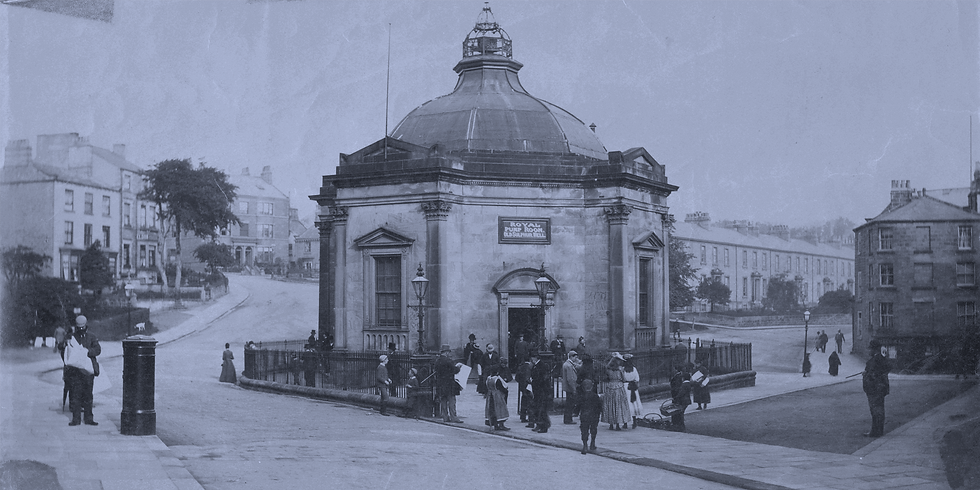
Beneath what's now the Royal Pump Room lies the Old Sulphur Well, reputed to be the strongest sulphur spring in Europe.
At its Victorian peak, the well drew as many as 15,000 visitors in a single summer, served from inside the Pump Room by attendants like Betty Lupton, who dispensed glasses of the water for the better part of six decades.
An 1841 Act required that the water also be made available, for free, to anyone who couldn't afford the Pump Room's fee - a tap installed outside the building for exactly that purpose, which still stands and still works, today.

Bogs Field - the source beneath it all
If there's one place that deepens the story, it's Bogs Field. Thirty-six separate mineral springs rise to the surface within this single stretch of ground - more unique mineral wells in one place than anywhere else recorded on earth.
Historically, the springs kept the field permanently waterlogged, which is exactly how it got its name. For centuries this marshy ground was protected precisely because of what it held beneath it, eventually becoming the heart of what's now Valley Gardens - a place designed not to disguise the springs but to let people walk among them.