
where to go
Cold Bath Road takes its name from the Cold Bath or St. Mungo’s Spring at its upper end, one of the many sources that fed Harrogate’s development.
The road climbs out of the town, forming a linear neighbourhood rather than a contained quarter. Its growth was shaped by housing, local commerce, and the steady movement of people rather than grand planning.
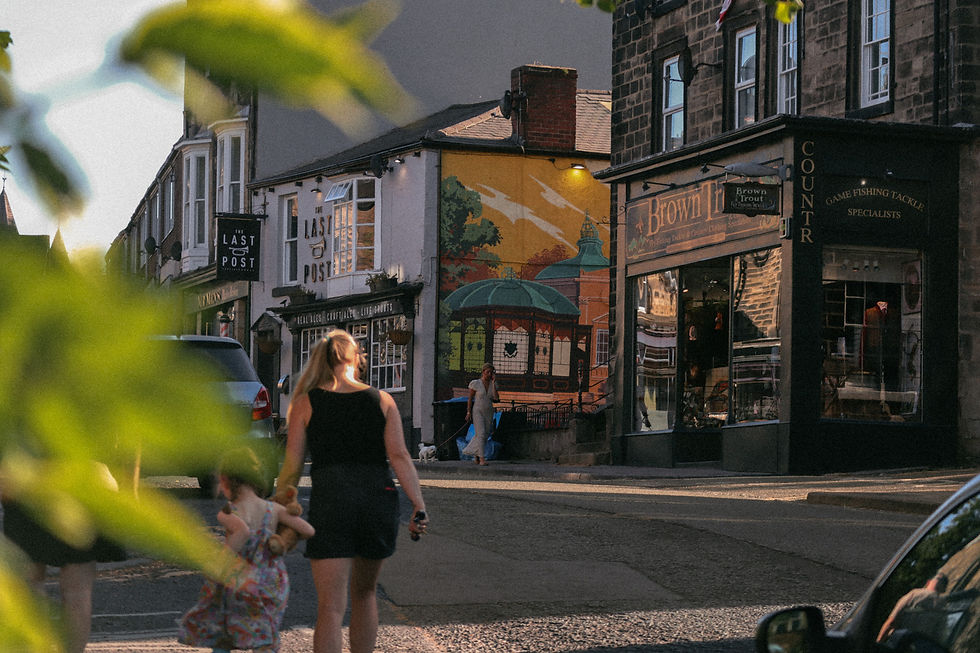

Cold Bath is one of Harrogate’s most characterful neighbourhood streets, with independent cafés, shops, restaurants and local businesses set among the homes of the southern side of town.
Its story begins with water. Long before it became known for shops and street life, Cold Bath Road was a route to the town’s cold bathing culture, linking the spa core below with springs, baths and treatment places further up the hill.
That older route can still be felt in the shape of the street. It does not have the straight, formal feel of Harrogate’s later planned streets. Instead, it bends and climbs, carrying something of the older lane that once led people towards the cure.
St Magnus Well and the Cold Bath Spring
Cold Bath takes its name from one of Harrogate’s older water stories. The former Cold Bath spring, associated with St Magnus Well, was part of the town’s wider spa landscape, where different waters were used for different kinds of treatment.
In the eighteenth and nineteenth centuries, visitors came to Harrogate not only to drink sulphur waters, but also to bathe, recover and follow prescribed routines. Cold immersion was once taken seriously as a cure for complaints ranging from gout to nervous disorders. The name Cold Bath still preserves that lost world of water, treatment and ritual.


Harlow Manor Hydro
Opposite the Cold Bath spring once stood Harlow Manor Hydro, one of the private hydropathic establishments that carried Harrogate’s spa culture beyond the main civic baths. It began life in the world of large houses and villa landscapes on the western edge of town, before expanding into a substantial hydro hotel.
Harlow Manor offered a residential version of the cure. Visitors could stay for a managed regime of water treatments, rest, fresh air, careful diet and gentle exercise, all within the comfort of a large hotel-like house rather than the more public setting of the Royal Baths. It belonged to the same culture as the Old Swan, Cairn Hydro and the other hydropathic establishments that made Harrogate a town of cure houses as well as wells.
Set within its own grounds, Harlow Manor helped make Cold Bath Road part of a wider spa circuit, linking springs, baths, gardens, hotels, hydros and the open edge of Harlow Moor. Like many large Victorian and Edwardian spa buildings, it was later demolished in the twentieth century, leaving only the name Harlow Manor Park as a trace of the lost hydro.
From Spa Lane to Neighbourhood Street
Cold Bath Road long predates the more formal Victorian grid of Harrogate. Its winding line gives it a softer, older feel, more like a former village lane or spa approach road than a planned shopping street.
Over time, the area changed. Quarries below the road helped supply stone for Harrogate’s building boom, while villas, boarding houses, apartments and small hotels grew around the street to serve visitors staying for the spa season. Today, that layered history survives in a different form: an independent neighbourhood street, still full of movement, local life and quiet links to Harrogate’s cure.
