
CURE

For centuries, Harrogate has been understood not simply as a place to visit, but as a place to recover, rebalance and restore.
Visitors did not come only to drink the waters or bathe. They came to follow a considered way of life for a period of time. Walking in clean air. Spending time in gardens and pinewoods. Attending concerts, lectures and assemblies. Eating well. Sleeping well. Taking gentle exercise. Exploring the surrounding countryside. Immersing themselves in culture, society and ritual.
Healing was understood as something shaped by environment, movement, culture and time, not by a single treatment alone.
In the eighteenth and nineteenth centuries, the term Harrogate Cure appeared in guidebooks and seasonal pamphlets.
These publications set out how visitors should structure their days. When to take the waters. Where to walk. Which gardens, rooms and promenades to frequent. What cultural life was on offer. Which excursions were recommended beyond the town.
The Cure was not a prescription in the modern medical sense. It was a curated environment for wellbeing. A whole-town approach to health.
![Pump Room 2 [Credit George Eglese].jpg](https://static.wixstatic.com/media/d4a71e_d287dfb900f441f98ca11bcabf3cbdfd~mv2.jpg/v1/fill/w_980,h_636,al_c,q_85,usm_0.66_1.00_0.01,enc_avif,quality_auto/Pump%20Room%202%20%5BCredit%20George%20Eglese%5D.jpg)

Harrogate Cure is a way of understanding the town.
The Cure acts as a lens through which Harrogate can be read and experienced. It brings together:
Mineral waters and wells
Landscape, air and walking
Architecture, gardens and public spaces
Culture, society and everyday life
Food, movement, rest and ritual
Seen together, these form an ecosystem rather than a set of attractions. This is what made Harrogate distinctive historically, and what still sets it apart today.
Anatomy of a Spa Town
Across Europe, spa towns developed a recognisable structure. Springs formed the nucleus. Around them grew pump rooms, bathhouses, gardens, halls and promenades. Beyond these lay parks, woodland, villas and open countryside.
Water generated architecture. Architecture shaped society. Landscape framed recovery.
Harrogate followed this pattern, while developing a character distinctly its own.

Karlovy Vary, Czechia
Growing the spa landscape
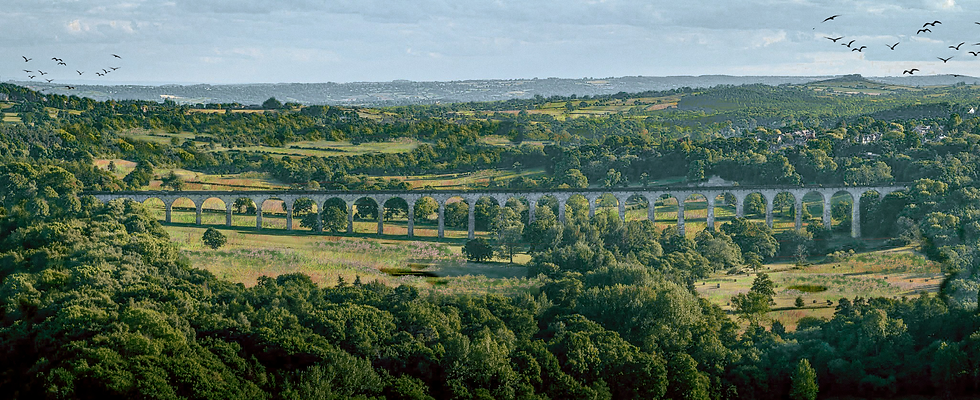
The historic spa extended beyond its buildings into a wider therapeutic landscape of parks, promenades, woodland and open countryside.
Visitors walked, rode and exercised as part of the Cure, absorbing fresh air, long views and carefully framed nature designed to support recovery and reflection.
Harrogate’s Wildbelt renews this tradition for the 21st century. Following the Nidd, Crimple and Oak Beck, it restores a living spa landscape around the town. Not only for walking and contemplation, but for biodiversity, community agriculture and common stewardship.
![Foraging on the Stray 2 [Credit George Eglese].jpg](https://static.wixstatic.com/media/d4a71e_7750d96b2c0f4c6f93480e8f22dd7988~mv2.jpg/v1/fill/w_980,h_653,al_c,q_85,usm_0.66_1.00_0.01,enc_avif,quality_auto/Foraging%20on%20the%20Stray%202%20%20%5BCredit%20George%20Eglese%5D.jpg)
.jpg)
STORY
![Trinity Church, Stray [Credit George Eglese].jpg](https://static.wixstatic.com/media/d4a71e_b3a55284173a4e16919609ec3572f0c5~mv2.jpg/v1/fill/w_980,h_1470,al_c,q_85,usm_0.66_1.00_0.01,enc_avif,quality_auto/Trinity%20Church%2C%20Stray%20%5BCredit%20George%20Eglese%5D.jpg)
Explore

EXPERIENCE
